
The Rapidly Approaching 2026 Electoral Showdown
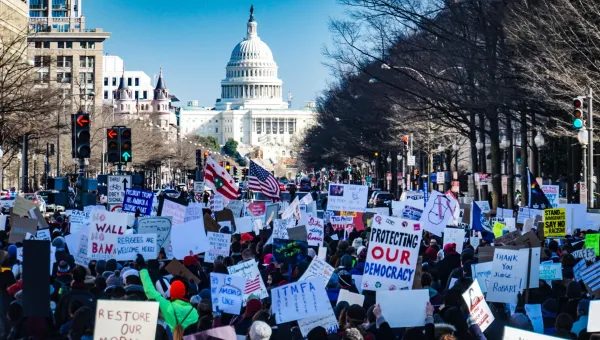
Image via New Hampshire Public Radio (creative commons)
The November midterm elections are shaping up to be a showdown unlike anything the world has witnessed. Although the American Empire is in decline, it still exerts enormous influence over much of the world. Acting as though it can dominate the globe through bombs, assassinations, and drones, the U.S. government has proven increasingly incapable of negotiating lasting agreements or achieving decisive military victories.
Inflation in America has become a fact of life, driven in large part by perpetual war. It is impossible to add hundreds of billions of dollars to the military budget without fueling inflation. This administration has shown no ability to restore the nation's economic health while devoting vast American resources to building weapons and waging wars that kill civilians around the world.
If America still had genuinely fair elections, Republicans would, in my view, face a crushing defeat in the midterms. Instead, our electoral system is under assault by those in power. The most important (three of eleven) examples discussed below are the threat of Immigration and Customs Enforcement (ICE) agents at polling places, the SAVE Act, and the dismantling of the Election Assistance Commission.
Donald Trump is many things: a convicted felon, a man found liable for sexual abuse, a racist, a misogynist, and, in my opinion, profoundly ignorant of history and war. Above all, however, he is driven by narcissism. That trait makes it unlikely that he will willingly abandon the conflicts he has escalated or admit failure. He will use every tool available to avoid appearing defeated. For that reason, the threat of further military escalation—including the possibility of nuclear confrontation—cannot be dismissed.
Trump attacked American democracy on January 6, 2021, by attempting to overturn an election he had lost. The Biden administration failed to hold him fully accountable for those actions. January 6 demonstrated his willingness to attack the electoral process itself. There is little reason to believe he will respect legal limits when political power is at stake.
Having observed elections over many years in Columbus, Ohio, as an election observer, I know firsthand that local election officials work diligently to ensure free and fair elections. At the Free Press, we also recognize that elections can be manipulated at higher levels of power. At the local level, however, election workers consistently perform their duties with professionalism and integrity. If elections are undermined, it is far more likely to occur through abuses of political or financial power than through the myth of widespread voting by non-citizens.
If a President of the United States can interfere with elections without meaningful consequences, the authoritarianism now descending upon the country will become firmly entrenched. The world's most powerful nation risks permanent rule by an authoritarian political class. Whatever label one chooses—fascism, oligarchy, or ruling class—the American democratic experiment will survive only as an idea rather than a reality.
The SAVE Act: What the Bill Actually Does
The SAVE Act Has Nothing To Do With Saving Elections. It's About Ending Them.
By Dean Blundell
The SAVE Act (Safeguard American Voter Eligibility) would require every American citizen to provide documentary proof of citizenship—such as a passport or birth certificate—to register to vote in federal elections. This requirement would apply not only to first-time voters but also whenever a voter updates a registration after moving, changing a name, or changing party affiliation. Each update would require an in-person visit to an election office with the required documents.
The legislation would also make mail-in voter registration largely ineffective. Although voters could still submit registration forms by mail, they would ultimately be required to appear in person with their documentation before the registration deadline.
Online voter registration, now available in most states, would face major obstacles because the bill provides no practical mechanism for submitting citizenship documents electronically. At the same time, it imposes criminal penalties on election officials who mistakenly register someone whose documentation is later judged inadequate.
Community voter-registration drives at colleges, churches, grocery stores, and public events would also become far less effective. Volunteers could distribute registration forms, but they could no longer help people complete the registration process without requiring them to appear in person with documentation. Critics argue that this would significantly reduce participation in such efforts.
Source: Dean Blundell, "The SAVE Act Has Nothing To Do With Saving Elections. It's About Ending Them."
The legislation is opposed by the League of Women Voters, numerous civil-rights organizations, and the Southern Poverty Law Center. Opponents argue that it is designed to suppress voter participation by creating unnecessary barriers that disproportionately affect women, married voters who have changed their names, low-income citizens, and other groups.
Additional reading:
The Threat of ICE at Polling Places
There would be no practical reason for the administration to announce in advance whether Immigration and Customs Enforcement agents will be deployed near polling locations. Nevertheless, concerns have arisen following public statements suggesting that such actions have not been ruled out.
Critics fear that the presence of ICE agents at polling places—particularly in heavily immigrant or minority communities—could intimidate eligible voters and discourage participation. They also warn that highly publicized arrests near early-voting locations could have a chilling effect on turnout.
The Independent reported under the headline:
"White House's chilling warning about midterm elections: 'Can't guarantee an ICE agent won't be around polling locations.'"
According to the report, the White House declined to rule out the possibility that Immigration and Customs Enforcement agents could be deployed near polling places during the November elections.
The Brennan Center for Justice has also addressed the issue, arguing that sending ICE agents to polling places would violate federal law protecting the right to vote.
Election Assistance Commission
The Election Assistance Commission has effectively been dismantled by the current administration.
According to ProPublica, President Donald Trump removed the remaining members of the bipartisan Election Assistance Commission, leaving the agency unable to carry out many of its responsibilities as the administration moves to reshape election administration before the midterm elections.
ProPublica reported that Trump dismissed Democratic commissioners Benjamin Hovland and Thomas Hicks, while Republican commissioner Christy McCormick was permitted to resign, effectively leaving the commission without functioning leadership.
Other Threats to Election Integrity
Pardons for January 6 Participants
Perhaps the clearest signal that future attacks on American democracy will carry few consequences came when President Trump granted clemency to many of those convicted for crimes arising from the January 6 attack on the U.S. Capitol. Whether viewed as pardons, commutations, or acts of political loyalty, the message was unmistakable: those who attempted to overturn a presidential election would be rewarded rather than condemned. Future participants in election interference can reasonably expect similar treatment if their actions serve those in power.
Pressure on the Justice Department
The Department of Justice has historically served as an independent institution responsible for enforcing election laws without partisan influence. That independence is increasingly under pressure. A Justice Department used to investigate political opponents while ignoring violations committed by allies would undermine one of the most important safeguards protecting American elections.
Pressure on State Election Officials
Since the 2020 election, election officials across the country have faced unprecedented harassment, threats, and political pressure. Many experienced administrators have resigned or retired. Replacing independent professionals with partisan loyalists weakens public confidence in elections and increases the risk that election administration becomes a political weapon rather than a public service.
Weakening Voting Rights Enforcement
Federal enforcement of voting-rights protections has steadily declined in recent years. Civil-rights organizations warn that without vigorous enforcement of existing laws, states may adopt policies that make voting more difficult for minority communities, students, the elderly, and low-income citizens.
Election Certification
The counting of ballots is only one part of a democratic election. Certification of the final results is equally essential. The effort to pressure officials to reject certified election results in 2020 demonstrated that the greatest threat to democracy may come after the votes have been counted. Americans should expect similar attempts to challenge legitimate election results in future elections.
Election Security
Election security depends on well-funded local election offices, secure voting equipment, cybersecurity protections, and trained personnel. Weakening those resources leaves election systems more vulnerable to technical failures, cyberattacks, and public distrust.
The Big Lie
Perhaps the most effective attack on American elections has been the relentless promotion of false claims that elections are routinely stolen. Repeating those allegations despite the absence of credible evidence has convinced millions of Americans that election results cannot be trusted. Once citizens lose confidence in the electoral process itself, democracy becomes increasingly difficult to sustain.
Federal Authority During Election Disputes
Constitutional scholars have warned about the possibility that federal law-enforcement agencies or even military forces could be used during periods of election-related unrest. While such authority is intended for extraordinary circumstances, the possibility of its political misuse deserves close public scrutiny.
Independent Election Institutions
The Election Assistance Commission was created after the disputed 2000 presidential election to strengthen election administration and promote bipartisan cooperation. Weakening or disabling institutions specifically designed to improve election integrity removes important safeguards at precisely the moment they are needed most.
Conclusion
The Trump administration does not respect the laws or the tradition of free elections. The SAVE Act, threats involving ICE, and the dismantling of the Election Assistance Commission are only part of a broader effort to control the outcome of American elections. These developments, taken together, reveal a systematic campaign to weaken the institutions that have traditionally protected democratic elections. Once it is established that the government can control the results, the experiment of democracy will have ended.